

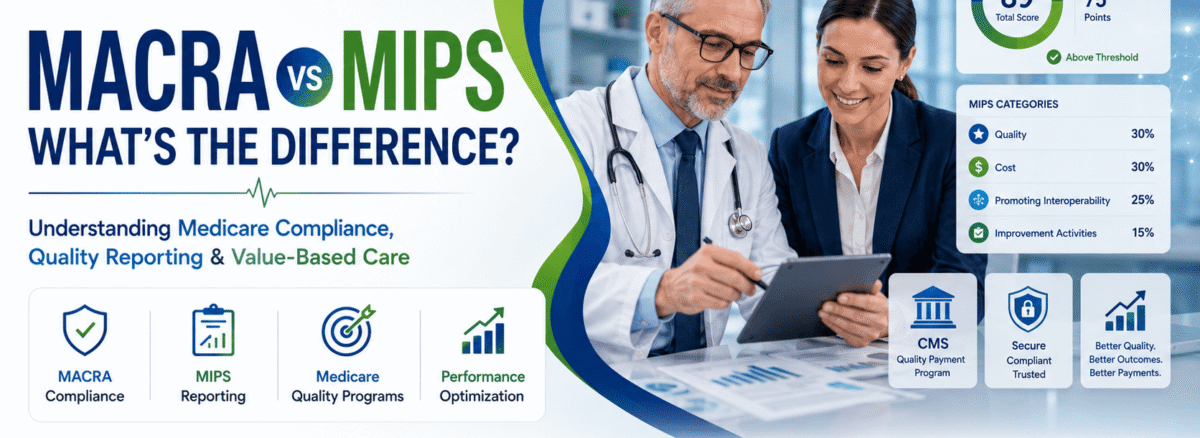

Ask ten providers what MACRA and MIPS mean, and you’ll get ten different answers, most of them half right. The two terms get thrown around like they’re interchangeable, and that mix-up costs practices real money every reporting year. One is a federal law. The other is a scoring program that the law created. Knowing which is which changes how you plan for compliance and how you protect your Medicare reimbursement.
MACRA is the legislation that replaced Medicare’s old payment formula and built the Quality Payment Program. MIPS is one of the two reporting paths inside that program, the one most independent providers and small practices actually use. NexCure LLC works across both, handling MACRA compliance and MIPS reporting so nothing slips through.
What Is MACRA?
MACRA stands for the Medicare Access and CHIP Reauthorization Act, passed by Congress in 2015. It got rid of the Sustainable Growth Rate formula, a payment method that billing teams dreaded because it kept threatening massive, across-the-board cuts to physician pay almost every year.
MACRA did two things. First, it ended that broken formula for good. Second, it built the Quality Payment Program (QPP), which changed how CMS decides what to pay providers. Instead of paying purely for the volume of services delivered, CMS started tying part of Medicare reimbursement to the quality and cost-efficiency of care. That’s the whole point of the law: shift Medicare from paying for quantity toward paying for value.
MACRA itself doesn’t score anyone. It’s the framework. The actual scoring happens through the two paths under QPP: Advanced Alternative Payment Models (APMs) and MIPS.
What Is MIPS?
MIPS, the Merit-based Incentive Payment System, is where most eligible clinicians land if they aren’t part of an Advanced APM. It folded three older reporting programs, PQRS, the Value-Based Payment Modifier, and Meaningful Use, into a single combined score.
That score comes from four categories, weighted like this for the 2026 performance year:
- Quality (30%): clinical outcome and process measures tied to your specialty
- Cost (30%): calculated by CMS from claims data, no separate submission required
- Promoting Interoperability (25%): how well your EHR supports data exchange and patient access
- Improvement Activities (15%): documented steps that improve care delivery or patient engagement
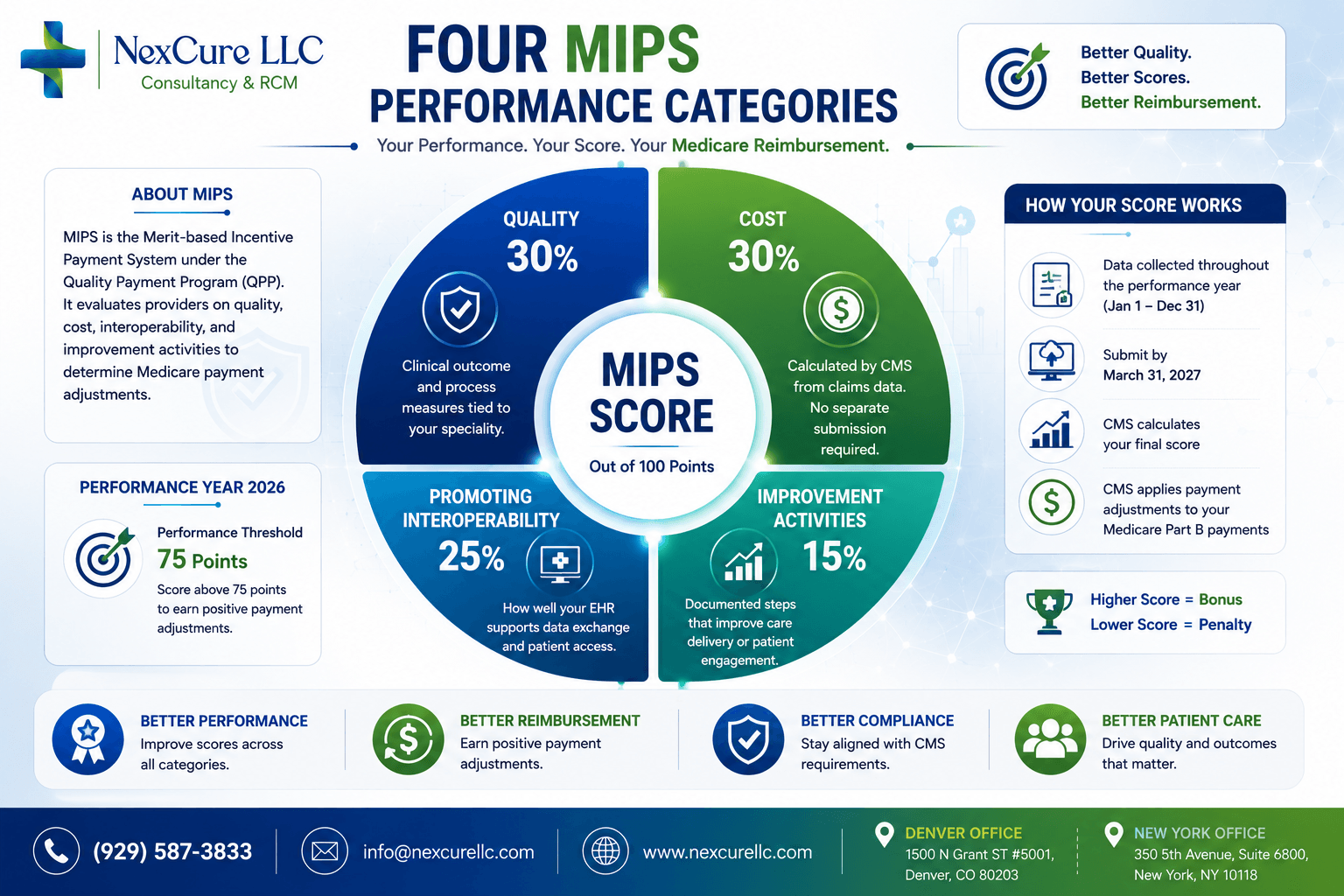
Add those together, and you get a final score out of 100. CMS compares that score against the performance threshold, locked at 75 points through the 2028 performance year, to set your payment adjustment. Land above it, and you’re looking at a bonus. Fall below it, and the penalty scales down to as much as 9% off your Medicare Part B pay.
There’s more than one way to report MIPS data, too. Traditional MIPS is the original path, where you pick measures across all four categories yourself. MIPS Value Pathways (MVPs) group measures around a specialty or condition instead, with 27 pathways available for the 2026 performance year, including newly added tracks for interventional radiology, pathology, and vascular surgery. The APM Performance Pathway (APP) exists for practices already inside a Shared Savings Program ACO. None of this is mandatory to memorize. It’s exactly why MIPS reporting services exist: to match a practice with the pathway that scores best for its specialty instead of defaulting to the same generic measures as everyone else.
MACRA vs MIPS: The Real Distinction
MACRA | MIPS | |
What it is | Federal law, passed in 2015 | Reporting program created under the law |
Purpose | Replaced the SGR formula, built the QPP | Scores clinicians on quality, cost, and care improvement |
Who touches it | CMS, policymakers, payment structure | Individual providers and practices, every reporting year |
What “compliance” means | Following QPP rules in general | Selecting measures, submitting data, and hitting the 75-point mark |
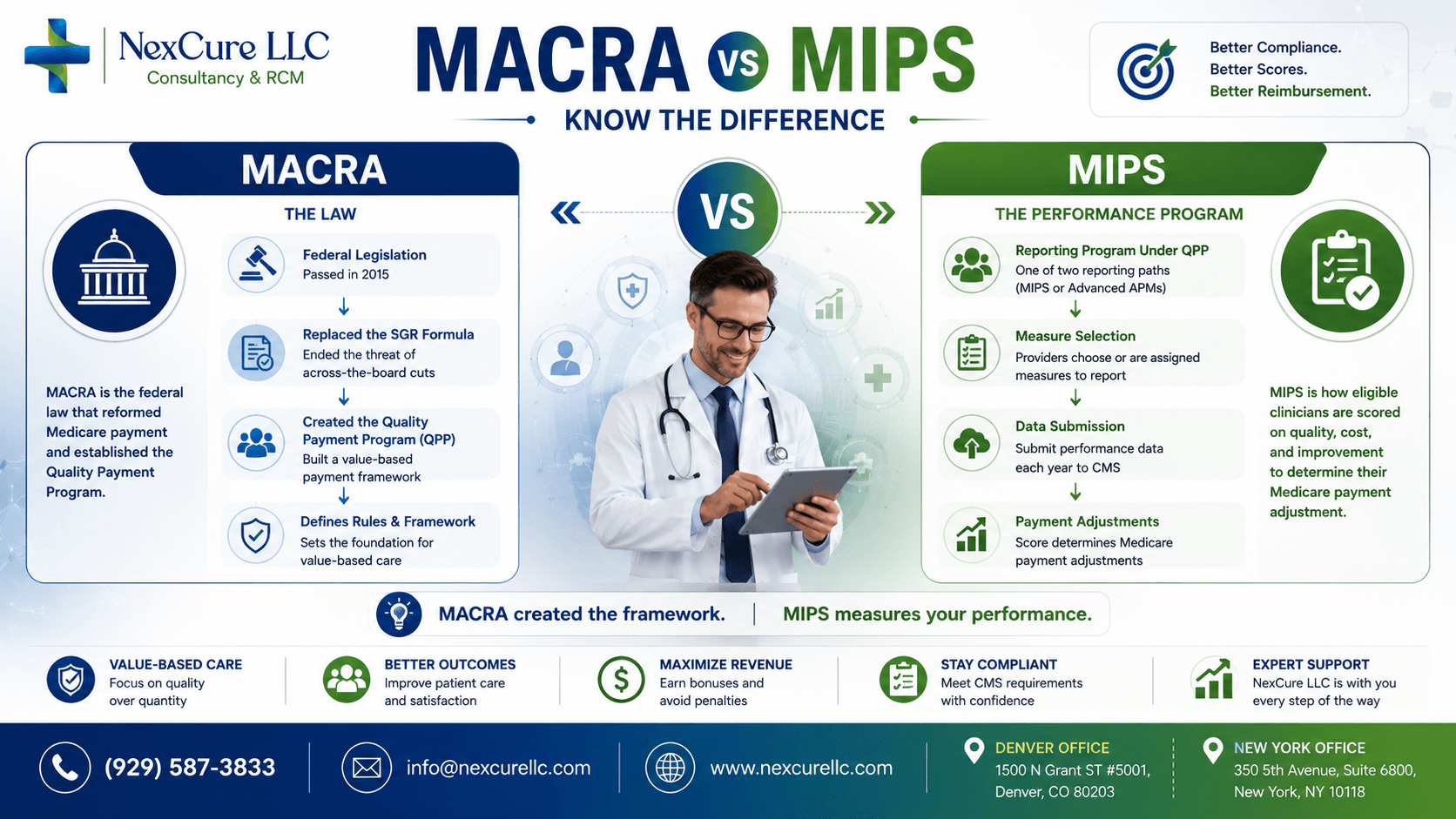
Think of it this way: MACRA is the rulebook. MIPS is the test you sit based on the rulebook. You don’t “do” MACRA day to day, you do MIPS. But every deadline, every point threshold, and every penalty percentage inside MIPS exists because MACRA wrote the rules first.
Why the Difference Actually Matters
Providers who treat the two terms as one and the same tend to miss the parts that cost them money. Some assume MIPS participation is optional when it isn’t. Eligibility is based on Medicare billing volume (more than $90,000 in Part B allowed charges), patient count, and covered services, checked twice a year by CMS. Others assume a general sense of “we do value-based care” covers their reporting duty, when MIPS demands specific measure selection, data collection starting January 1, and submission by the following March 31.
For the 2026 performance year, CMS projects the median final score will land near 89, comfortably above the 75-point bar. Most practices clear it without much drama. But solo practitioners and small practices continue to carry the highest penalty risk, and a few missed measures or a poorly chosen improvement activity is often the gap between a bonus and a real revenue hit.

Where NexCure LLC Fits In
This is exactly the gap our MACRA compliance services and MIPS reporting services are built to close. We check eligibility at the start of the year, choose measures that fit your specialty instead of generic defaults, track your score in real time instead of waiting on CMS feedback months later, and submit through CMS-qualified registries so nothing gets flagged. Practices working with us have consistently landed above the 75-point threshold, without the reporting eating into time better spent on patients. That distinction between the law and the reporting program isn’t academic. It’s the difference between a compliance plan that actually protects your Medicare revenue and one that just sounds good on paper.
The Bottom Line
MACRA built the system. MIPS is how you get graded inside it. Mixing the two up isn’t just a vocabulary slip; it’s usually the reason practices miss measures, miss deadlines, or miss out on a bonus they were eligible for all along. Get the distinction right, and the reporting itself gets a lot less painful.
Want help figuring out where your practice stands for 2026? NexCure LLC‘s MACRA compliance services and MIPS reporting services are built for exactly this.

Leave feedback about this