

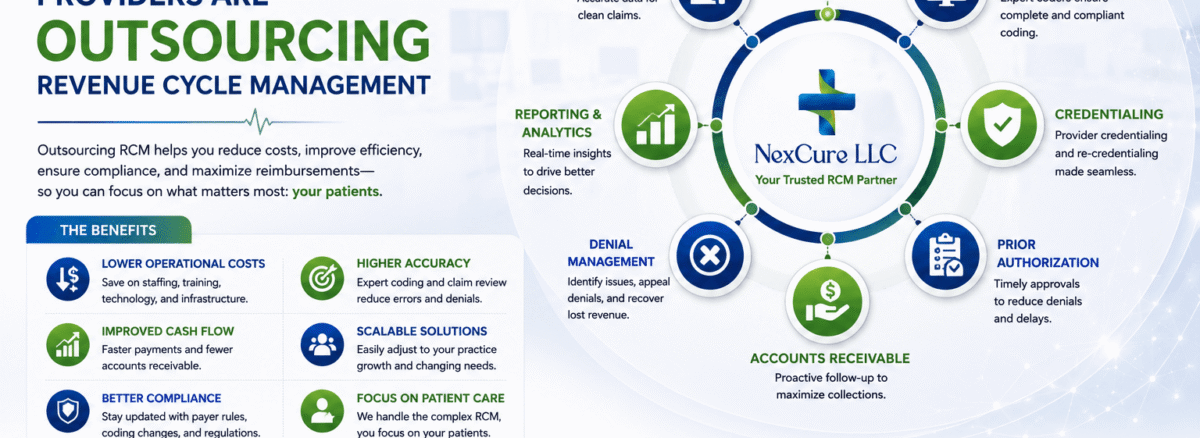
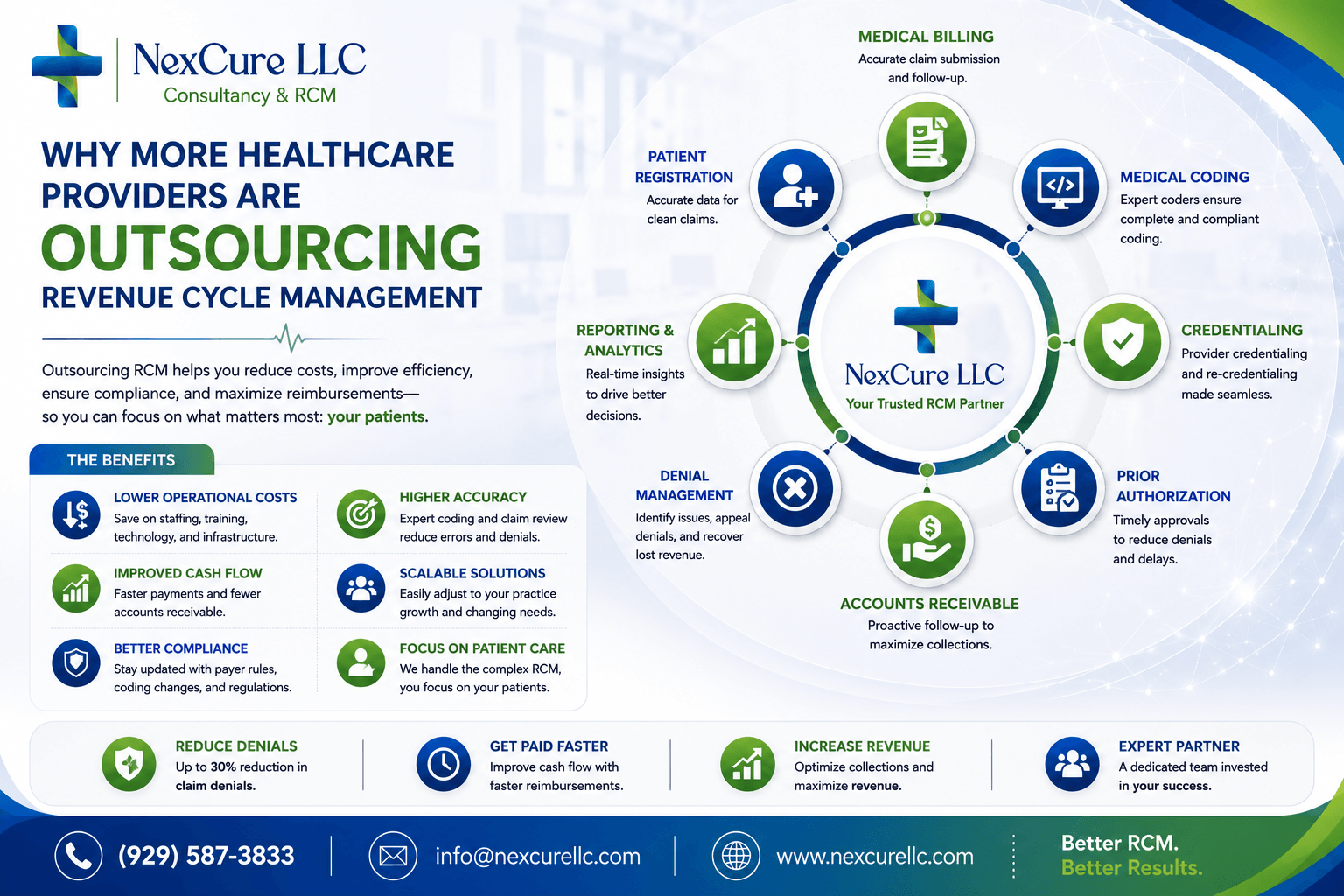
Every practice that keeps billing entirely in-house is really running two businesses at once: medicine and a small insurance-claims operation nobody planned to build. That second business needs coders who track annual code changes, staff who chase down denials, and systems that talk to a dozen different payers. Most practices don’t notice how much that second business costs them until they stop running it themselves. By then, the numbers are usually hard to ignore: unpaid claims sitting past 90 days, a coder out on leave with nobody trained to cover, and a growing list of payer updates nobody had time to read.
Quick answer: Providers outsource revenue cycle management to cut claim denials, get paid faster, control staffing costs, and stay current on payer rules that shift every year. The outsourced RCM market in the US is projected to nearly double within four years, and NexCure LLC is one of the partners built to handle that workload end-to-end.
Fewer Denials, Caught Before They Happen
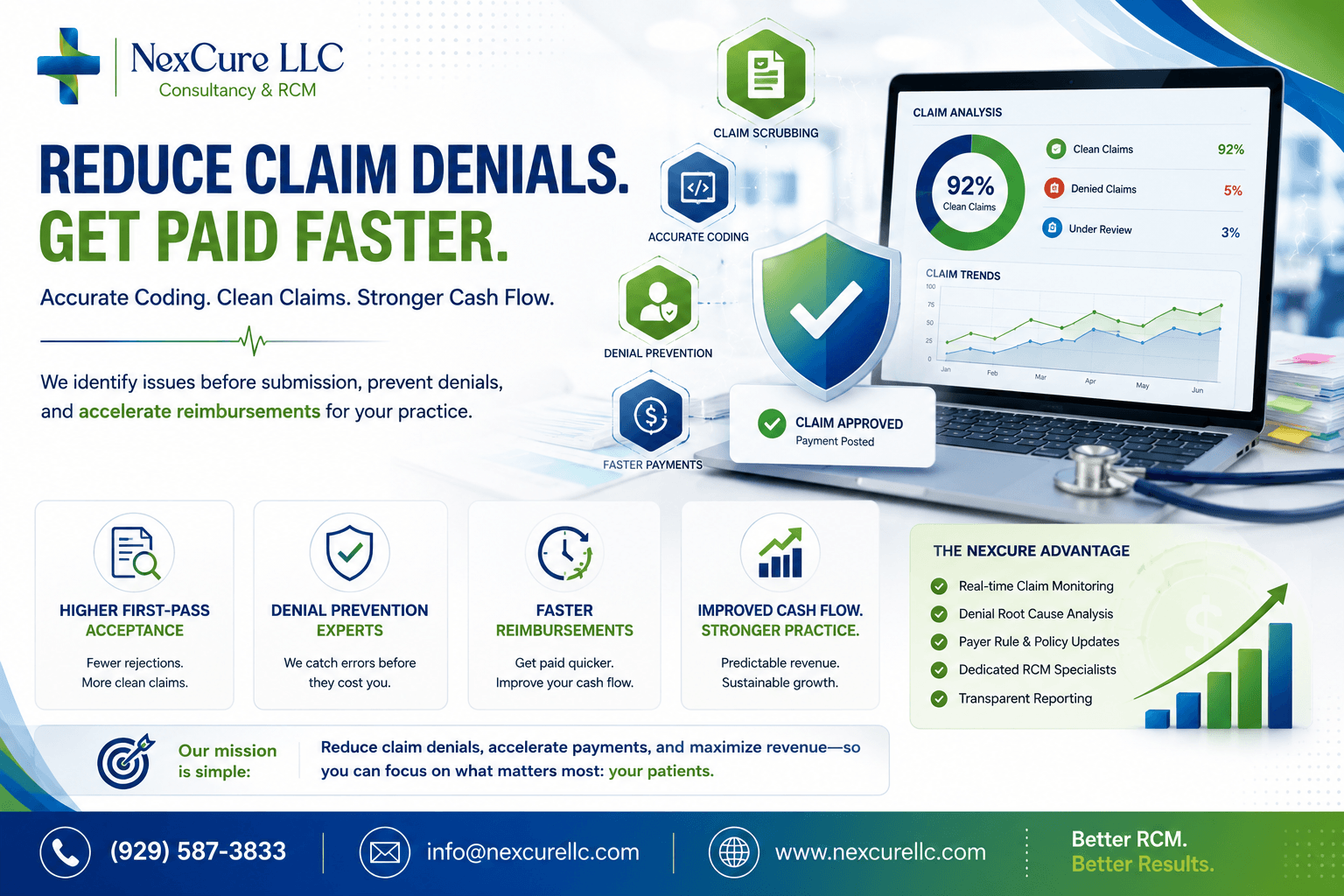
Something like 10 to 15% of medical claims get denied the first time they’re submitted, and only about half of those denials ever get successfully appealed. Every denial means delayed payment at best and lost revenue at worst. A dedicated RCM team lives inside payer rules all day. They catch a missing modifier or a mismatched diagnosis code before the claim goes out, instead of finding it three months later in an appeal letter.
Faster Reimbursement, Steadier Cash Flow
Clean claims get paid faster. That sounds obvious, but the compounding effect isn’t. A practice sitting on 45 days in accounts receivable instead of 25 is financing its own payers, interest-free, for weeks at a time. Outsourced teams built around claim scrubbing, eligibility checks, and same-day submission shrink that gap, which matters more to a practice’s actual cash position than almost any other single change it can make.
Lower Cost Than Building the Department Yourself
Running billing in-house means salaries, benefits, ongoing training on code changes, and software licenses that need renewing, whether claim volume is up or down that month. Outsourcing turns a fixed overhead cost into a variable one tied to what actually gets billed and collected. For smaller practices, especially, that difference is often the gap between hiring a billing manager and hiring another clinician.
Staying Current Without a Full-Time Compliance Team
Coding sets update every year. Prior authorization rules shift payer by payer. A practice relying on one in-house biller to track all of it is one vacation or resignation away from missed updates. A specialized RCM partner’s entire job is watching those changes, so a practice doesn’t have to build a compliance function just to keep up with one.
Staffing That Doesn’t Walk Out the Door
Billing and coding roles turn over constantly, and training a replacement takes months, all while claims and follow-ups pile up in the meantime. Outsourcing removes that staffing risk from the practice’s shoulders. The vendor absorbs turnover, training, and coverage gaps, so a single resignation never turns into a backlog.
Room to Scale Without a Hiring Cycle
A practice adding a new provider, opening a second location, or moving into more specialties needs billing capacity to match right away, not after a hiring search. Outsourced RCM scales with claim volume instead of headcount, so growth doesn’t stall out waiting for the next hire to onboard.
Data and Analytics Without the Software Bill
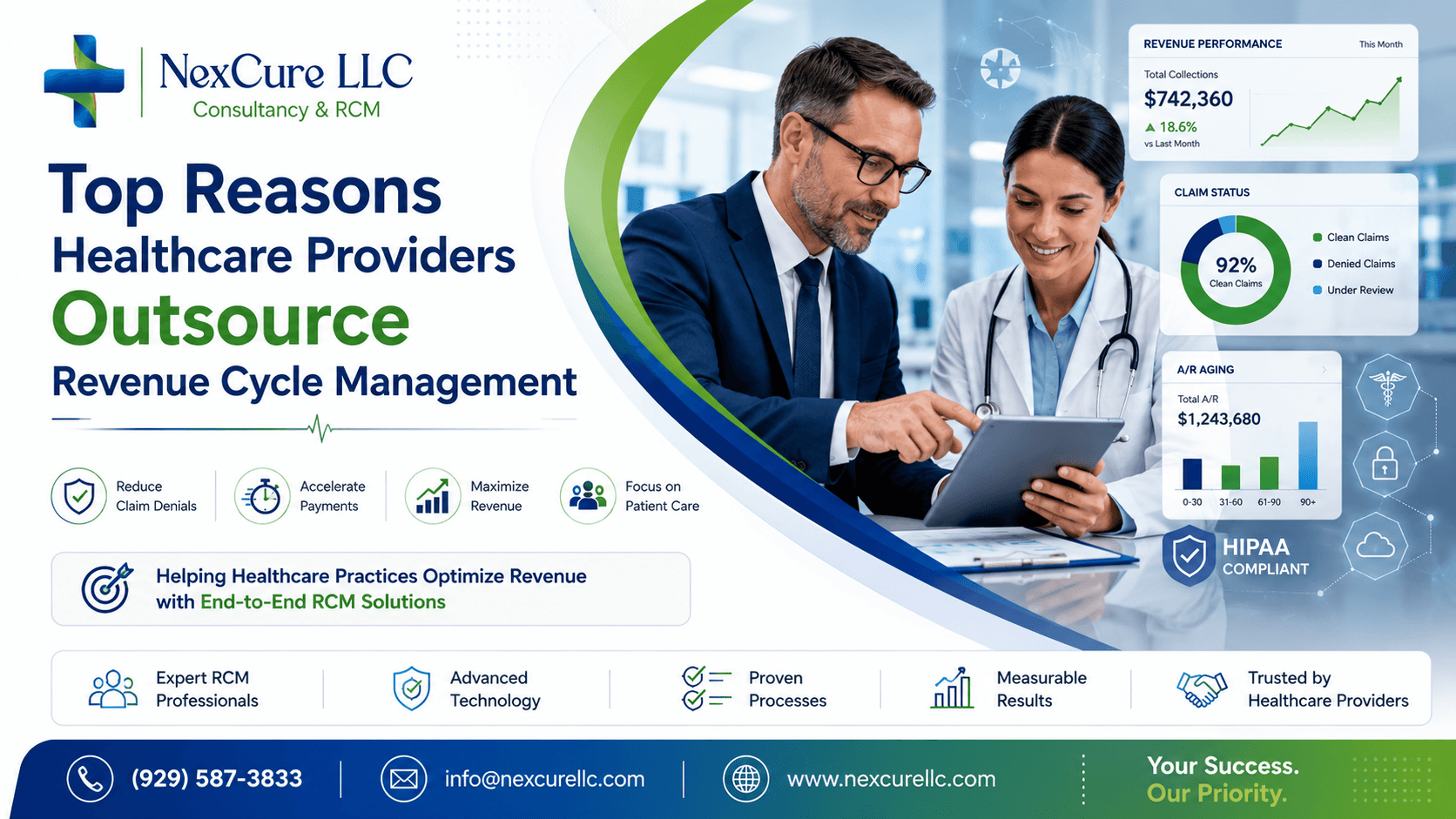
Modern RCM runs on dashboards: denial trends by payer, collection rates by provider, and aging buckets that flag exactly which claims need follow-up today instead of next month. Building that kind of reporting in-house means licensing analytics software, integrating it with an EHR, and paying someone to maintain it. Most outsourced RCM partners already have that infrastructure built and paid for across every client they serve, so a single practice gets enterprise-level visibility into its own numbers without the enterprise-level price tag. That visibility is what turns billing from a black box into something a practice can actually manage.
Why Revenue Cycle Outsourcing in the USA Is Growing So Fast
The numbers back up what’s happening on the ground. The outsourced RCM market in the US surpassed $34 billion in 2025 and is projected to nearly double to $67 billion within four years, according to Research and Markets. Around 70% of hospitals and health systems already plan to expand their outsourcing arrangements, and more than half of revenue cycle leaders say their operations will get less effective unless something changes, pointing to rising denials, aging receivables, and staffing shortages as the biggest pressure points.
Regulatory complexity adds to the pressure, too. Recent Medicare physician fee schedule updates alone added hundreds of new billing codes for digital health, remote monitoring, and behavioral health services, and each one needs someone who knows exactly how to bill it correctly.
Automation is part of the story, too. Industry estimates put the potential savings from AI and automation in the revenue cycle at up to $360 billion a year. Most practices can’t build that technology themselves. Outsourcing is often the only realistic way to benefit from it without the capital investment.

Where NexCure LLC Fits In
This is exactly the workload NexCure LLC takes off a practice’s plate: coding accuracy reviews, denial pattern analysis, eligibility checks, and revenue leakage reports, all handled by a team that does this full-time instead of squeezing it between other front-desk duties. Practices working with us typically see denials drop, collections speed up, and staff get their time back for the parts of the job that actually need a person in the room with a patient.
The Bottom Line
Billing was never supposed to be a practice’s second business, but for most, it quietly became one anyway. Outsourcing revenue cycle management hands that second business to people who run it as their only one, with the coding depth, denial expertise, and staffing stability most practices can’t build alone.
Want to see what outsourcing revenue cycle management could do for your numbers? NexCure LLC’s RCM team is ready to take a look.
Leave feedback about this